
I'm Annika de Friend, and here's my story.
For most of those years, my business partner and I were running on momentum. Growing, hiring, chasing the next number. We were a great team, but we'd never really stopped to define what we wanted the business to become.
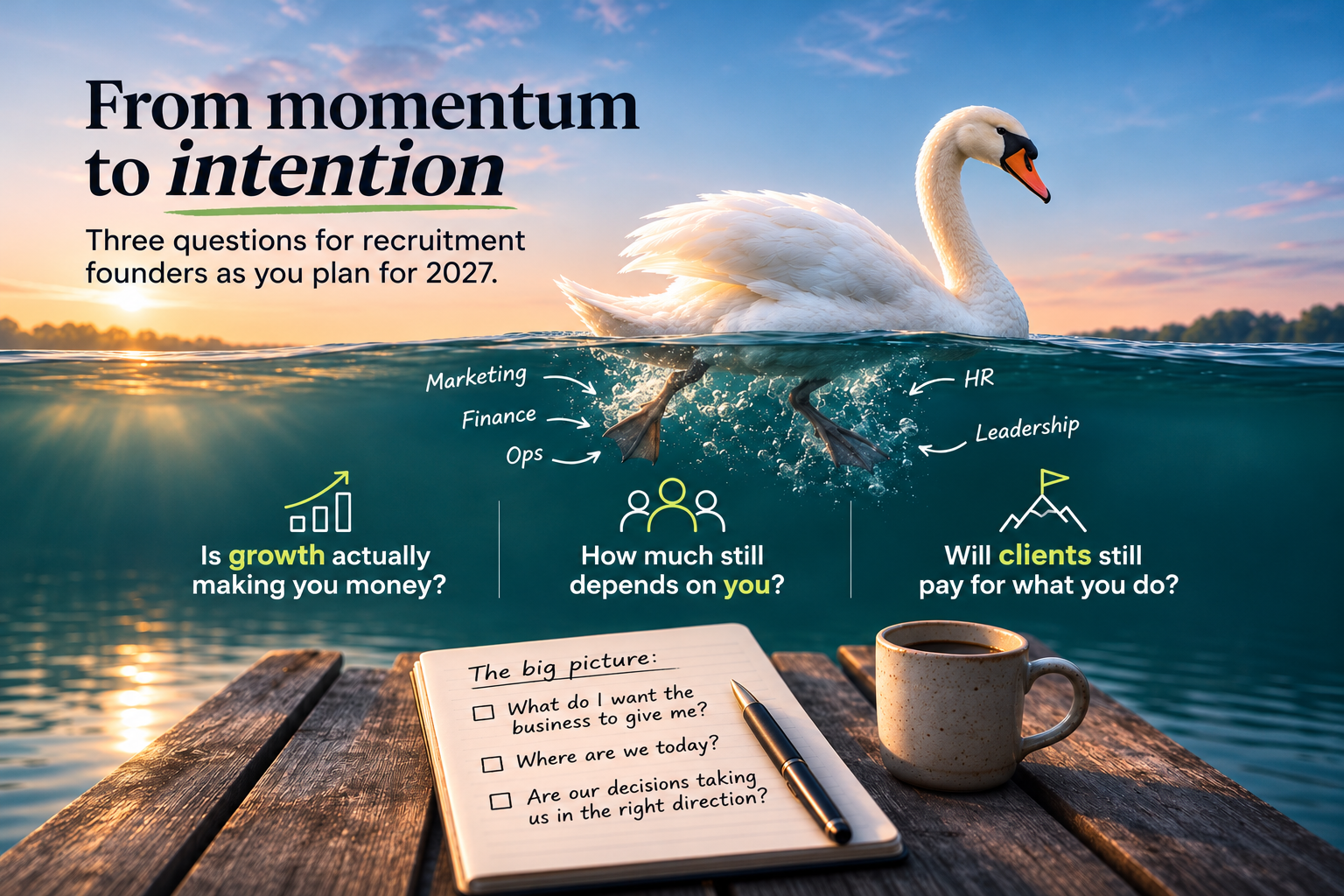
Most of the time I felt like a swan. Calm on top, paddling like mad underneath. Marketing hat, finance hat, ops hat, HR hat, leadership hat, switching constantly, with everyone expecting me to have the answers.
Then things changed. I had two young children, the leadership team had become much smaller, and for the first time I had the freedom to shape the business around what I wanted from it.
So I sat down properly and asked myself what I actually wanted the business to give me. It wasn't more of the same.
I made Source smaller, on purpose. More specialist. We became much more deliberate about how we operated, introduced the reporting, processes and commercial discipline to improve performance and profit went up.
That experience shapes the work I do with recruitment founders today. The first question isn't necessarily "how big do you want to be?" It's "what do you want the business to give you?"
For some, it's a bigger agency. For others, it's more profit, a team that runs without them, or something they can sell one day. There's no right answer. But if you haven't defined your destination, how do you know whether the decisions you're making are taking you closer to it?
As 2027 approaches, these are the three questions I'd encourage every founder to consider.
Is growth actually making you money?
Bigger and busier isn't necessarily better. More people, more clients and more revenue don't automatically translate into more profit.
When I deliberately made Source smaller, turnover reduced but profitability improved. The difference was that we became much more intentional about how the business was structured, managed and measured.
There's nothing wrong with wanting to build a larger agency. But as your business grows, the way you manage it needs to develop too. What worked when you had five people won't necessarily work when you have fifteen or thirty.
You need financial reporting that tells you more than what you've billed, clear expectations around productivity and accountability, and the ability to identify where performance is slipping before it affects your bottom line.
Do you know your net fee income per head, your profit margins and what's driving them? Can you see which parts of the business are performing well and which need attention?
If growth is what you want, make sure it's delivering the return you expect.
How much still depends on you?
Simon's test was a month away from the business. It's the right one. Here's how I'd run it. You're completely off-grid for four weeks. Phone off, inbox closed, nobody calling you "just quickly". What actually happens?
Things stall. Or the desks keep running, but decisions pile up until you're back. Perhaps it runs well apart from a couple of big calls. Or it genuinely runs because decisions and relationships are owned by other people.
Most founders I speak to land somewhere in the first two. That's not a criticism. It's what can happen when you build a business from the desk up.
Being involved isn't the problem. Being needed for everything is.
There's nothing wrong with being heavily involved if that's what you enjoy and where you add the most value. But if you want to grow, step back or simply spend more time on the parts of the business that matter most to you, it's worth understanding where that dependency sits and what needs to change.
Will clients still pay for what you do?
AI is changing how recruitment businesses operate, and work that once required significant time and effort can increasingly be done more efficiently. As that becomes the norm, clients will expect more from their recruitment partners.
If your value proposition is predominantly about supplying candidates, what makes your business different from the alternatives available to clients?
We challenged ourselves on this at Source. Under our traditional contingent model, we were filling roughly one in five vacancies. We looked hard at what was stopping us, what clients actually valued and how we could deliver a more effective service.
We developed a productised offering with a defined process and clear commitments on both sides. For vacancies managed through that product, we achieved a 100% fill rate, and we successfully moved the majority of our permanent recruitment work onto that model.
That wasn't just about improving delivery. It changed our proposition and gave clients a stronger reason to work with us differently.
So what do your clients genuinely value beyond access to candidates? And how could you build a stronger proposition around that value?
These three questions are connected. Profitability, founder dependency and your client proposition can all be affected by the way the business is structured, led and managed. Sometimes what looks like one problem has its roots somewhere else entirely.
How ready are you for 2027?
I've put together a short 2027 Readiness Scorecard for recruitment founders. It's designed to help you step back and take an honest look at where your business stands today, what is working well and what might need attention.
You can also choose to send it to me and I'll personally review it. Within two working days, you'll receive your Readiness Report: your score and founder profile, a heatmap across seven areas of the business, three observations and the one thing I'd tackle first if it were my agency.
You don't need to have all the answers. But it's worth knowing what you're trying to build, where you are today and whether the decisions you're making are moving you in the right direction.
About Annika
Annika de Friend is a strategic and commercial adviser to recruitment founders. She spent nearly 20 years building and leading Source, growing it to £13m turnover and 45 people before deliberately reshaping it into a smaller, more specialist and more profitable business. Today, she helps founders build their businesses with intention, not just momentum.